STEP II 2020,第 6 題
繼續之前,請先閱讀題目(原題為英文)。題目載於 OCR 提供下載的 2020 年 STEP 試卷(zip 檔案)內的 STEP II 試卷: www.ocr.org.uk/Images/696589-2020-past-papers.zip
引子
有些變換(transformation)只要重複足夠多次,就會令一切回到原位。旋轉 \(90^\circ\) 要四步,反射則只要兩步。哪些 \(2 \times 2\) 矩陣(matrix)具有這種性質,即對某個 \(n\) 有 \(\mathbf{M}^n = \mathbf{I}\)?又怎樣判斷?
這道題令人意外之處,在於只需兩個數就足以判定:跡(trace)和行列式(determinant)。你不必知道那四個元素,只需知道 \(a + d\) 和 \(ad - bc\)。而且答案對現實世界有一個驚人的推論:它解釋了為甚麼晶體可以有 \(2\) 重、\(3\) 重、\(4\) 重和 \(6\) 重對稱,卻永遠沒有 \(5\) 重對稱。這條晶體學「定律」屹立了兩個世紀,直至 1982 年的一項發現才被打破,而該發現更贏得了諾貝爾獎。
動筆之前
每個 \(2 \times 2\) 矩陣都滿足 \(\mathbf{M}^2 - (\operatorname{tr}\mathbf{M})\mathbf{M} + (\det\mathbf{M})\mathbf{I} = \mathbf{0}\)(這是凱萊-哈密頓定理(Cayley–Hamilton theorem);把它乘開來驗證一下)。這對處理有關 \(\mathbf{M}^2\) 的問題有甚麼幫助?
它把 \(\mathbf{M}^2\) 用 \(\mathbf{M}\) 和 \(\mathbf{I}\) 表示出來:\(\mathbf{M}^2 = t\mathbf{M} - d\mathbf{I}\),其中 \(t = \operatorname{tr}\mathbf{M}\),\(d = \det\mathbf{M}\)。於是,關於 \(\mathbf{M}^2\) 的條件就變成一個把 \(\mathbf{M}\)、\(t\) 和 \(d\) 聯繫起來的條件。這就是整道題的關鍵。
逐步解題
階段 1 平方的跡
\(\mathbf{M}^2 = \begin{pmatrix} a^2 + bc & ab + bd \\ ac + cd & bc + d^2 \end{pmatrix}\),所以 \(\operatorname{tr}(\mathbf{M}^2) = a^2 + 2bc + d^2 = (a + d)^2 - 2(ad - bc)\)。■
階段 2 \(\pm\mathbf{I}\) 的平方根
假設 \(\mathbf{M}^2 = \mathbf{I}\)。把它代入 \(\mathbf{M}^2 = t\mathbf{M} - d\mathbf{I}\)。若 \(t \neq 0\),這說明 \(\mathbf{M}\) 是怎樣的矩陣?
若 \(\mathbf{M}^2 = \mathbf{I}\),則 \(\mathbf{I} = t\mathbf{M} - d\mathbf{I}\),所以 \(t\mathbf{M} = (1 + d)\mathbf{I}\)。若 \(t \neq 0\),則 \(\mathbf{M}\) 是 \(\mathbf{I}\) 的倍數,設為 \(c\mathbf{I}\),而 \(c^2 = 1\),所以 \(\mathbf{M} = \pm\mathbf{I}\),但這已被排除。因此 \(t = 0\),於是 \((1 + d)\mathbf{I} = \mathbf{0}\),所以 \(d = -1\)。
反過來,若 \(t = 0\) 且 \(d = -1\),則 \(\mathbf{M}^2 = t\mathbf{M} - d\mathbf{I} = \mathbf{I}\),而且 \(\mathbf{M} \neq \pm\mathbf{I}\),因為 \(\operatorname{tr}(\pm\mathbf{I}) = \pm2 \neq 0\)。■
至於 \(\mathbf{M}^2 = -\mathbf{I}\):代入後得 \(t\mathbf{M} = (d - 1)\mathbf{I}\)。若 \(t \neq 0\),則 \(\mathbf{M} = c\mathbf{I}\),其中 \(c^2 = -1\),這對實數 \(c\) 是不可能的。所以 \(t = 0\) 且 \(d = 1\)。反過來,由 \(t = 0\) 和 \(d = 1\) 可得 \(\mathbf{M}^2 = -\mathbf{I}\)。■
階段 3 四次方根
設 \(\mathbf{N} = \mathbf{M}^2\),則 \(\mathbf{M}^4 = \mathbf{I}\) 即是 \(\mathbf{N}^2 = \mathbf{I}\)。根據第 (ii) 部分,要麼 \(\mathbf{N} = \pm\mathbf{I}\),要麼 \(\operatorname{tr}\mathbf{N} = 0\) 且 \(\det\mathbf{N} = -1\)。為甚麼第二種情況不可能發生?
\(\det\mathbf{N} = \det(\mathbf{M}^2) = (\det\mathbf{M})^2 \geq 0\),所以 \(\det\mathbf{N} \neq -1\)。因此 \(\mathbf{N} = \mathbf{M}^2 = \pm\mathbf{I}\)。逆命題顯然成立。■
至於 \(\mathbf{M}^4 = -\mathbf{I}\):把第 (ii) 部分應用於 \(\mathbf{N} = \mathbf{M}^2\),可知它成立當且僅當 \(\operatorname{tr}(\mathbf{M}^2) = 0\) 且 \(\det(\mathbf{M}^2) = 1\),即 \(t^2 - 2d = 0\) 且 \(d^2 = 1\)。由於 \(t^2 = 2d \geq 0\),必須有 \(d = 1\),於是 \(t^2 = 2\)。所以 \[\mathbf{M}^4 = -\mathbf{I} \iff \det\mathbf{M} = 1 \text{ 且 } \operatorname{tr}\mathbf{M} = \pm\sqrt2. \qed\]
階段 4 一個不是旋轉的 \(\mathbf{I}\) 的八次方根
任何滿足 \(\mathbf{M}^4 = -\mathbf{I}\) 的矩陣都有 \(\mathbf{M}^8 = \mathbf{I}\)。旋轉 \(45^\circ\) 的矩陣的跡是 \(\sqrt2\),行列式是 \(1\);我們想找另一個跡和行列式都相同、但不是旋轉的矩陣。取 \[\mathbf{M} = \begin{pmatrix} \sqrt2 & -1 \\ 1 & 0 \end{pmatrix}, \qquad \operatorname{tr}\mathbf{M} = \sqrt2, \quad \det\mathbf{M} = 1.\] 根據第 3 步,\(\mathbf{M}^4 = -\mathbf{I}\),所以 \(\mathbf{M}^8 = \mathbf{I}\)。但 \(\mathbf{M}\) 既不是旋轉也不是反射,因為旋轉和反射都保持長度不變,而 \(\mathbf{M}\begin{pmatrix} 1 \\ 0 \end{pmatrix} = \begin{pmatrix} \sqrt2 \\ 1 \end{pmatrix}\) 的長度是 \(\sqrt3 \neq 1\)。■
回顧
凱萊-哈密頓定理把冪化為線性組合(linear combination)。\(2 \times 2\) 矩陣的每一個冪都是 \(\mathbf{M}\) 和 \(\mathbf{I}\) 的組合,其係數只取決於跡和行列式。
平方的行列式是非負的。這個簡單的事實在第 (iii) 部分排除了一整種情況。
跡和行列式是不變量(invariant)。兩個跡和行列式都相同的矩陣(且都不是 \(\mathbf{I}\) 的倍數),不論外表是否相似,取冪時的表現都一樣。
背後的數學
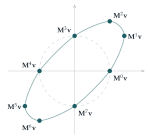
為甚麼說第 4 步的 \(\mathbf{M}\) 是「偽裝了的旋轉」?若存在可逆(invertible)矩陣 \(\mathbf{S}\) 使得 \(\mathbf{M} = \mathbf{SRS}^{-1}\),則稱兩個矩陣 \(\mathbf{M}\) 和 \(\mathbf{R}\) 相似(similar):它們在不同的坐標下表示同一個變換。相似矩陣有相同的跡和行列式,而且(對於不是 \(\mathbf{I}\) 的倍數的 \(2 \times 2\) 矩陣)逆命題也成立。所以任何跡為 \(\sqrt2\)、行列式為 \(1\) 的實矩陣都與 \(45^\circ\) 的旋轉相似,而在 \(\mathbf{S}\) 所給出的斜坐標下,它就只是在旋轉(圖 7.4.1)。一般而言,滿足 \(\mathbf{M}^n = \mathbf{I}\) 的 \(2 \times 2\) 實矩陣必定與某個旋轉或反射相似。
為甚麼晶體沒有五重對稱
晶體是原子有規律、重複的排列。晶體的旋轉對稱把原子所成的格(lattice)映射到它自身,所以在以這個格為基礎的坐標下,它由一個元素全是整數的矩陣給出。因此它的跡是整數。但是旋轉角為 \(\theta\) 的旋轉,在任何坐標下的跡都是 \(2\cos\theta\),而 \(2\cos\theta\) 只有在等於 \(-2, -1, 0, 1\) 或 \(2\) 時才是整數,也就是對應階(order)為 \(2\)、\(3\)、\(4\) 和 \(6\)(以及 \(1\))的旋轉。五重對稱需要 \(2\cos72^\circ = \frac{\sqrt5 - 1}{2}\),而這不是整數。這就是晶體學限制定理(crystallographic restriction theorem)。1982 年,Dan Shechtman 觀察到一種看似具有五重對稱的合金,起初還遭人嘲笑;後來才知道那是一種準晶體(quasicrystal),有序但沒有周期性,就像彭羅斯鋪磚(Penrose tilings)一樣,因此不在該定理的涵蓋範圍之內。他於 2011 年獲頒諾貝爾化學獎。
思維技巧
當題目涉及一個有很多參數的對象時,問問自己:是否只需這些參數的幾個組合,即那些轉換觀點後仍然不變的組合,就已經足夠?
在這裏,四個元素化約為兩個不變量,即跡和行列式,因為這個問題(「\(\mathbf{M}^n = \mathbf{I}\) 是否成立?」)並不取決於坐標。找到合適的不變量,往往是解決分類問題的關鍵。
延伸練習
三階的旋轉。試做 STEP II 2021,第 7 題 (載於 OCR 提供下載的 2021 年試卷 zip 檔案內)。它從一個具有不尋常性質的旋轉矩陣出發,最後得出一個結論,適用於所有立方為單位矩陣(identity matrix)的 \(2 \times 2\) 實矩陣。
六階。求跡和行列式須滿足的條件,使得 \(\mathbf{M}^6 = \mathbf{I}\),但 \(\mathbf{M}^2 \neq \mathbf{I}\) 且 \(\mathbf{M}^3 \neq \mathbf{I}\)。
晶體學限制。證明:若 \(\mathbf{M}\) 的元素全是整數,\(\det\mathbf{M} = 1\),且對某個 \(n\) 有 \(\mathbf{M}^n = \mathbf{I}\),則 \(\operatorname{tr}\mathbf{M} \in \{-2, -1, 0, 1, 2\}\)。找出一個階為 \(6\) 的整數矩陣。
以凱萊-哈密頓定理求冪。利用 \(\mathbf{M}^2 = t\mathbf{M} - d\mathbf{I}\),把 \(\mathbf{M}^3\) 和 \(\mathbf{M}^4\) 表示成 \(p\mathbf{M} + q\mathbf{I}\) 的形式,並藉此重新推導 \(\mathbf{M}^4 = -\mathbf{I}\) 的條件。
延伸閱讀
M. A. Armstrong, Groups and Symmetry(Springer)。內容包括晶體學限制和牆紙圖案的分類。
Marjorie Senechal, Quasicrystals and Geometry(Cambridge University Press)。準晶體與非周期有序結構的數學。
Gilbert Strang, Introduction to Linear Algebra(Wellesley-Cambridge)。相似矩陣與凱萊-哈密頓定理。