In an experiment, a particle \(A\) of mass \(m\) is at rest on a smooth horizontal table. A particle \(B\) of mass \(bm\), where \(b > 1\), is projected along the table directly towards \(A\) with speed \(u\). The collision is perfectly elastic.
Find an expression for the speed of \(A\) after the collision in terms of \(b\) and \(u\), and show that, irrespective of the relative masses of the particles, \(A\) cannot be made to move at twice the initial speed of \(B\).
In a second experiment, a particle \(B_1\) is projected along the table directly towards \(A\) with speed \(u\). This time, particles \(B_2, B_3, \ldots, B_n\) are at rest in order on the line between \(B_1\) and \(A\). The mass of \(B_i\) (\(i = 1, 2, \ldots, n\)) is \(\lambda^{n+1-i}m\), where \(\lambda > 1\). All collisions are perfectly elastic. Show that, by choosing \(n\) sufficiently large, there is no upper limit on the speed at which \(A\) can be made to move.
In the case \(\lambda = 4\), determine the least value of \(n\) for which \(A\) moves at more than \(20u\). You may use the approximation \(\log_{10}2 \approx 0.30103\).
The hook
Hold a tennis ball on top of a basketball and drop them together. The basketball bounces off the floor, and the tennis ball shoots up to several times the height you dropped it from, sometimes high enough to hit the ceiling. Try it outdoors.
Part (i) of the question shows that a single collision has a speed limit: however heavy the ball that hits it, a stationary ball cannot be sent off at more than twice the speed of the incoming one. Part (ii) shows how to break the limit: pass the motion down a chain of ever-lighter balls, and the speed multiplies at every step. The same idea sends space probes to the outer planets, and has been suggested as part of the mechanism of a supernova.
Before you start
From Section 10.1: if a mass \(M\) moving at speed \(u\) hits a stationary mass \(m\) elastically, what is the speed of \(m\) afterwards?
The result there (with the roles of the masses swapped) gives the speed of the struck particle as \(\frac{2M}{M + m}u\). Another way to remember it: in an elastic collision the relative velocity is reversed. If the heavy ball barely slows down, the light ball must leave at about \(u\) more than the heavy ball’s speed, that is about \(2u\).
Working it through
Stage 1 The speed limit
With \(M = bm\), the speed of \(A\) after the collision is \[v_A = \frac{2bm}{bm + m}\,u = \frac{2b}{b + 1}\,u.\]
How does \(\frac{2b}{b+1}\) compare with \(2\)? What happens as \(b \to \infty\)?
Since \(\frac{2b}{b + 1} = 2 - \frac{2}{b + 1} < 2\) for every \(b\), the speed of \(A\) is always less than \(2u\), however heavy \(B\) is. It approaches \(2u\) as \(b \to \infty\): an infinitely heavy ball would bounce \(A\) off as if from a moving wall.■
Stage 2 Passing it along a chain
In part (ii), each particle is \(\lambda\) times as heavy as the next one. What does part (i) say about each collision in the chain?
\(B_1\) (mass \(\lambda^n m\)) hits \(B_2\) (mass \(\lambda^{n-1}m\)), which is \(\lambda\) times lighter. By part (i) with \(b = \lambda\), \(B_2\) moves off at \(\frac{2\lambda}{\lambda + 1}u\). Then \(B_2\) hits \(B_3\), which is again \(\lambda\) times lighter, and \(B_3\) moves off at \(\bigl(\frac{2\lambda}{\lambda + 1}\bigr)^2u\). After \(n\) such collisions, the last one being \(B_n\) hitting \(A\), \[v_A = \Bigl(\frac{2\lambda}{\lambda + 1}\Bigr)^nu.\] (Later collisions between the \(B\)s can only push \(A\) further; they cannot slow it, since nothing ever hits \(A\) from in front.)
Is \(\frac{2\lambda}{\lambda + 1}\) bigger or smaller than \(1\)?
Since \(\lambda > 1\), \(2\lambda > \lambda + 1\), so the ratio \(r = \frac{2\lambda}{\lambda + 1}\) exceeds \(1\), and \(r^n \to \infty\) as \(n \to \infty\). So by taking \(n\) large enough, \(A\) can be made to move as fast as we like.■
Stage 3 Twenty times as fast
With \(\lambda = 4\), \(r = \frac85 = 1.6\), and we need \(1.6^n > 20\). Taking logarithms to base \(10\), \[\log_{10}1.6 = \log_{10}16 - 1 = 4\log_{10}2 - 1 \approx 0.20412, \qquad \log_{10}20 = 1 + \log_{10}2 \approx 1.30103,\] so we need \(n > \frac{1.30103}{0.20412} \approx 6.37\). The least value is \(n = 7\). (Indeed \(1.6^6 \approx 16.8\) and \(1.6^7 \approx 26.8\).)■
Looking back
Iterate a single result. Part (i) was used \(n\) times in part (ii), turning a bounded gain into an unbounded one.
A limit that is never reached. The bound \(2u\) is approached but never attained, so the right statement is a strict inequality.
Logarithms turn powers into products. The question of how many steps are needed became a division.
What’s really going on
The basketball and the tennis ball
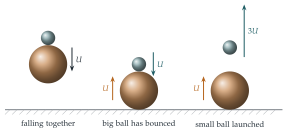
Let the two balls fall together from height \(H\), reaching the floor at speed \(U = \sqrt{2gH}\). Suppose everything is perfectly elastic and the basketball is much heavier. It bounces off the floor with speed \(U\) upwards, and immediately meets the tennis ball, still moving down at speed \(U\). In the basketball’s frame, the tennis ball approaches at \(2U\) and, bouncing off a very heavy object, leaves at \(2U\). Back in the ground frame, that is \(2U + U = 3U\) upwards (Figure 10.2.1). Since height is proportional to the square of the launch speed, the tennis ball rises to \(9H\).
Real balls are not perfectly elastic. With coefficient of restitution \(e\) and mass ratio \(M/m\), the tennis ball leaves at speed \(\frac{Me(2 + e) - m}{M + m}U\). STEP I 2014 Q10, in the exercises, uses a measured height to work backwards to the mass ratio.
Gravitational slingshots
A space probe flying past a planet does not touch it, but gravity acts like a very soft elastic collision with a very heavy object. In the planet’s frame, the probe swings round and leaves with the same speed it arrived with. If the planet is moving towards the probe at speed \(V\), then in the Sun’s frame the probe can gain up to \(2V\), exactly as the tennis ball does. The two Voyager probes, launched in 1977, used a rare alignment of the outer planets to pass from Jupiter to Saturn (and, for Voyager 2, on to Uranus and Neptune), gaining speed at each encounter. Without these gravity assists, the journey to Neptune would have taken about thirty years instead of twelve. The energy comes from the planet, which slows down by an immeasurably small amount.
In 1968 W. R. Mellen described in the American Journal of Physics a “superball rebound projectile” made by stacking several balls of decreasing size, and noted that the top ball can be launched at many times the impact speed. Astrophysicists have pointed out a loose analogy with a core-collapse supernova: the infalling outer layers of a star rebound off the stiff, dense core, and a shock wave carries momentum outwards into ever less dense material, accelerating it to enormous speeds. Demonstrations of the stacked-ball effect are used to explain the idea to students, though real supernovae involve much more physics, including neutrinos, than bouncing balls.
The thinking skill
When a process is a repetition of one simple step, solve the step once and compose it.
A gain factor less than \(2\) per step becomes unbounded after many steps, because the factors multiply. At university this is the idea behind transfer matrices, multi-stage amplifiers and multi-stage rockets (Section 10.3): the gain of a chain is the product of the gains of its links.
Try this next
The real thing. (From STEP I, 2014.) A ball of mass \(M\) and radius \(R\) is released from rest with its centre at height \(H + R\), with a ball of mass \(m\) and radius \(r\) on top. The coefficient of restitution for every impact is \(e\). Show that, bouncing alone, the large ball would rise until its centre is at height \(R + He^2\). Given \(R = 0.2\), \(r = 0.05\), \(H = 1.8\), \(e = \frac23\) and that the small ball’s centre reaches height \(4.5\), show that \(M/m = 9\).
An inelastic chain. (From STEP I, 2017.) Particles \(P_1, P_2, \ldots\) of masses \(\lambda m, \lambda^2m, \ldots\) lie at \(x = 1, 2, \ldots\), and a particle of mass \(m\) hits \(P_1\) at speed \(u\); the coefficient of restitution is \(e\). Show that \(P_1\) moves off at \(\frac{1 + e}{1 + \lambda}u\). Find the speed of \(P_n\) after its first collision, and show that if \(e > \lambda\) each particle is involved in exactly two collisions. What happens if \(\lambda e = 1\)?
Three balls. Three perfectly elastic balls are stacked, each much lighter than the one below. Show that the top ball leaves at \(7U\) and rises to \(49H\). With \(k\) balls, show that the top one leaves at \((2^k - 1)U\).
Where does the energy come from? In part (ii), show that the total kinetic energy is conserved even though \(A\)’s speed is unbounded. What happens to the heavy particles?
Further reading
David Morin, Introduction to Classical Mechanics (Cambridge University Press), Chapter 5, which includes the stacked-ball problem.
W. R. Mellen, “Superball rebound projectiles”, American Journal of Physics 36 (1968). Short and fun.
Gary Flandro, “Fast reconnaissance missions to the outer solar system utilizing energy derived from the gravitational field of Jupiter”, Astronautica Acta 12 (1966). The paper that proposed the Voyager “grand tour”.