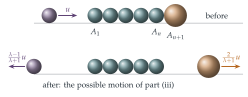
The identical uniform smooth spherical marbles \(A_1, A_2, \ldots, A_n\), where \(n \geq 3\), each of mass \(m\), lie in that order in a smooth straight trough, with each marble touching the next. The marble \(A_{n+1}\), which is similar to \(A_n\) but has mass \(\lambda m\), is placed in the trough so that it touches \(A_n\). Another marble \(A_0\), identical to \(A_n\), slides along the trough with speed \(u\) and hits \(A_1\). It is given that kinetic energy is conserved throughout.
Show that if \(\lambda < 1\), there is a possible subsequent motion in which only \(A_n\) and \(A_{n+1}\) move (and \(A_0\) is reduced to rest), but that if \(\lambda > 1\), such a motion is not possible.
If \(\lambda > 1\), show that a subsequent motion in which only \(A_{n-1}\), \(A_n\) and \(A_{n+1}\) move is not possible.
If \(\lambda > 1\), find a possible subsequent motion in which only two marbles move.
The hook
Pull back one ball of a Newton’s cradle and let it go: one ball flies out at the other end. Pull back two, and two fly out. Why? Why not one ball at twice the speed, or three balls at two-thirds of the speed? Both would carry the right momentum.
The answer begins with the two great conservation laws of mechanics. Momentum and energy together are much more restrictive than either alone, and they rule out most of the outcomes you might imagine. This question uses them as constraints: not to calculate what happens, but to decide what can happen. That way of thinking, with conservation laws as rules that every possible outcome must obey, runs through the whole of physics.
Before you start
A marble of mass \(m\) moving at speed \(u\) hits a stationary marble of mass \(M\), and kinetic energy is conserved. What are the velocities afterwards? What if \(M = m\)?
Let the velocities afterwards be \(p\) and \(q\). Momentum gives \(mp + Mq = mu\) and energy gives \(mp^2 + Mq^2 = mu^2\). Writing these as \(m(u - p) = Mq\) and \(m(u - p)(u + p) = Mq^2\) and dividing, \(u + p = q\). Then \[p = \frac{m - M}{m + M}\,u, \qquad q = \frac{2m}{m + M}\,u.\] When \(M = m\), the first marble stops and the second moves off at speed \(u\): the two simply exchange velocities. That is why the marbles of equal mass pass the motion along the line.
Working it through
Stage 1 Only the last two move
Suppose only \(A_n\) (velocity \(p\)) and \(A_{n+1}\) (velocity \(q\)) move afterwards. Write down the conservation laws. Which marble’s motion constrains the sign of \(p\)?
Momentum and energy give \[mp + \lambda mq = mu, \qquad \tfrac12mp^2 + \tfrac12\lambda mq^2 = \tfrac12mu^2.\] These are the equations for a marble of mass \(m\) hitting one of mass \(\lambda m\), so (apart from the solution \(p = u\), \(q = 0\), which would need \(A_n\) to pass through \(A_{n+1}\)) \[p = \frac{1 - \lambda}{1 + \lambda}\,u, \qquad q = \frac{2}{1 + \lambda}\,u.\] If \(\lambda < 1\), both are positive and \(p < q\): \(A_n\) follows \(A_{n+1}\) but more slowly, so they separate, and everything is consistent. If \(\lambda > 1\), then \(p < 0\): \(A_n\) moves backwards. But \(A_{n-1}\) is at rest directly behind it, touching it, and \(A_n\) cannot pass through it. So this motion is impossible.■
Stage 2 Three marbles
Now suppose only \(A_{n-1}\), \(A_n\) and \(A_{n+1}\) move, with velocities \(a\), \(b\), \(c\). What inequalities must \(a\), \(b\), \(c\) satisfy, given which marbles are at rest and which are behind which?
The marble \(A_{n-2}\) is at rest behind \(A_{n-1}\) (it exists, since \(n \geq 3\)), so \(a \geq 0\). And no marble can overtake the one in front, so \(a \leq b \leq c\). Altogether \(0 \leq a \leq b \leq c\). The conservation laws are \[a + b + \lambda c = u, \qquad a^2 + b^2 + \lambda c^2 = u^2.\]
Square the momentum equation and compare it with the energy equation. What is left?
Squaring, \(u^2 = a^2 + b^2 + \lambda^2c^2 + 2ab + 2\lambda ac + 2\lambda bc\). Subtracting the energy equation, \[0 = \lambda(\lambda - 1)c^2 + 2ab + 2\lambda c(a + b).\] With \(\lambda > 1\) and \(a, b, c \geq 0\), every term on the right is non-negative, so every term is zero. In particular \(c = 0\), and then \(0 \leq a \leq b \leq c\) forces \(a = b = 0\). But then the total momentum is \(0\), not \(mu\). Contradiction: this motion is impossible.■
Notice the structure of the argument. Squaring the momentum equation produces cross terms like \(2ab\), and the energy equation has none. The difference measures how “spread out” the motion is. Can you see why the same argument rules out any outcome in which only \(A_k, \ldots, A_{n+1}\) move with non-negative velocities, when \(\lambda > 1\)?
Stage 3 Two marbles that can move
If the marbles moving forwards must all be at the far end, and that fails, perhaps one marble moves backwards. Which marble is free to move backwards?
Only \(A_0\) has nothing behind it. Try: \(A_0\) moves with velocity \(p\) (possibly negative), \(A_{n+1}\) with velocity \(q\), and all the others are at rest. The conservation laws are again those of a collision between masses \(m\) and \(\lambda m\), so \[p = -\frac{\lambda - 1}{\lambda + 1}\,u, \qquad q = \frac{2}{\lambda + 1}\,u.\] \(A_0\) bounces back, \(A_{n+1}\) moves forwards, and the marbles in between stay at rest, all consistent. It is exactly as if \(A_0\) had hit \(A_{n+1}\) directly, with the line of equal marbles in between acting as a perfect messenger.■
Looking back
Conservation laws as constraints. We never followed the collisions in detail. We asked which outcomes are allowed by momentum, energy and geometry.
Physical inequalities matter. “Marbles cannot pass through each other” gave the inequalities \(0 \leq a \leq b \leq c\), and these, not the conservation laws, ruled out parts (i) and (ii).
Square and subtract. Comparing the square of the momentum with the energy gives a sum of cross terms that must vanish.
What’s really going on
Why one ball comes out
In a Newton’s cradle of equal balls, suppose \(k\) balls leave together at speed \(w\). Momentum gives \(kw = u\) and energy gives \(kw^2 = u^2\). Dividing, \(w = u\) and \(k = 1\). So among outcomes where the departing balls move together, only “one ball at the original speed” obeys both laws. Two balls at half speed carry the right momentum but only half the energy; one ball at twice the speed would have the right momentum only if it were half a ball.
But this does not settle the matter. With \(n\) balls there are \(n\) unknown velocities and only two conservation laws, so there are infinitely many outcomes that obey both (try finding one with three balls moving at different speeds). Which one happens depends on how the balls deform during contact. In the early 1980s Frank Herrmann and his colleagues showed that the familiar behaviour depends on the shock passing along the line without spreading out, which happens for hard steel balls with tiny gaps between them. With soft balls, or balls pressed tightly together, the cradle behaves less cleanly, and careful measurements show that the other balls always move a little.
Conservation laws and symmetry
Where do the conservation laws come from? In 1918 Emmy Noether proved a theorem that is one of the foundations of modern physics: every continuous symmetry of a physical system gives a conserved quantity. If the laws of physics are the same here as one metre to the left (symmetry under translation in space), momentum is conserved. If they are the same today as tomorrow (symmetry under translation in time), energy is conserved. If they are the same in every direction (rotational symmetry), angular momentum is conserved. You will meet Noether’s theorem in a second-year course on Lagrangian mechanics; this chapter uses its consequences throughout.
In 1668 the Royal Society invited solutions to the problem of colliding bodies. John Wallis treated inelastic collisions, and Christopher Wren and Christiaan Huygens independently solved the elastic case. Huygens’s key insight was to change frame: view the collision from a boat moving with the centre of mass, where two equal balls simply bounce back with their speeds reversed, and then transform back to the shore. He also noticed that a certain quantity, the sum of the masses times the squares of the speeds, was the same before and after, though it was another century before kinetic energy was recognised as a conserved quantity in its own right.
The thinking skill
When a process is too complicated to follow, list the quantities that cannot change, and see which outcomes they allow.
This is how physicists reason about collisions in particle accelerators, where the detailed interactions are unknown but momentum, energy and charge must balance. Combined with an inequality (here, that marbles cannot pass through each other), it can prove that an outcome is impossible.
Try this next
The same problem again. (From STEP I, 2006.) Particles \(A_1, \ldots, A_n\) lie at rest in a trough; \(A_{n-1}\) has mass \(m\) and \(A_n\) has mass \(\lambda m\) with \(\lambda > 1\). A particle \(A_0\) of mass \(m\) hits \(A_1\) with speed \(u\). Show that it is impossible for exactly one particle to be moving after all collisions, or for only \(A_{n-1}\) and \(A_n\), or only \(A_{n-2}\), \(A_{n-1}\), \(A_n\). Given that exactly two particles move, find their speeds.
Following the collisions. Model the impact in part (iii) as a sequence of separate two-marble collisions, starting with \(A_0\) hitting \(A_1\). Follow the sequence through and show that it ends in the motion found in part (iii).
Two balls in. In a cradle of five equal balls, two balls are released together and hit the other three with speed \(u\). Show that “two balls leave with speed \(u\)” is consistent with both conservation laws, and find another outcome that is.
Light end. If \(\lambda < 1\), follow the sequence of two-marble collisions. Do any marbles other than \(A_n\) and \(A_{n+1}\) end up moving?
Further reading
David Morin, Introduction to Classical Mechanics (Cambridge University Press), Chapter 5. Conservation of momentum and energy, with many problems on collisions.
Frank Herrmann & Peter Schmälzle, “Simple explanation of a well-known collision experiment”, American Journal of Physics 49 (1981). Why Newton’s cradle works.
Dwight Neuenschwander, Emmy Noether’s Wonderful Theorem (Johns Hopkins University Press). An accessible account of the link between symmetry and conservation.