The domain of the function \(\mathrm{f}\) is the set of all \(2 \times 2\) matrices and its range is the set of real numbers. Thus, if \(\mathbf{M}\) is a \(2 \times 2\) matrix, then \(\mathrm{f}(\mathbf{M}) \in \mathbb{R}\).
The function \(\mathrm{f}\) has the property that \(\mathrm{f}(\mathbf{MN}) = \mathrm{f}(\mathbf{M})\mathrm{f}(\mathbf{N})\) for any \(2 \times 2\) matrices \(\mathbf{M}\) and \(\mathbf{N}\).
You are given that there is a matrix \(\mathbf{M}\) such that \(\mathrm{f}(\mathbf{M}) \neq 0\). Let \(\mathbf{I}\) be the \(2 \times 2\) identity matrix. By considering \(\mathrm{f}(\mathbf{MI})\), show that \(\mathrm{f}(\mathbf{I}) = 1\).
Let \(\mathbf{J} = \begin{pmatrix} 0 & 1 \\ 1 & 0 \end{pmatrix}\). You are given that \(\mathrm{f}(\mathbf{J}) \neq 1\). By considering \(\mathbf{J}^2\), evaluate \(\mathrm{f}(\mathbf{J})\).
Using \(\mathbf{J}\), show that, for any real numbers \(a\), \(b\), \(c\) and \(d\), \[\mathrm{f}\begin{pmatrix} a & b \\ c & d \end{pmatrix} = -\mathrm{f}\begin{pmatrix} c & d \\ a & b \end{pmatrix} = \mathrm{f}\begin{pmatrix} d & c \\ b & a \end{pmatrix}.\]
Let \(\mathbf{K} = \begin{pmatrix} 1 & 0 \\ 0 & k \end{pmatrix}\) where \(k \in \mathbb{R}\). Use \(\mathbf{K}\) to show that, if the second row of the matrix \(\mathbf{A}\) is a multiple of the first row, then \(\mathrm{f}(\mathbf{A}) = 0\).
Let \(\mathbf{P} = \begin{pmatrix} 1 & 1 \\ 0 & 1 \end{pmatrix}\). By considering the matrices \(\mathbf{P}^2\), \(\mathbf{P}^{-1}\), and \(\mathbf{K}^{-1}\mathbf{PK}\) for suitable values of \(k\), evaluate \(\mathrm{f}(\mathbf{P})\).
The hook
The determinant of a \(2 \times 2\) matrix is \(ad - bc\). Where does that formula come from, and why is it so important? One answer is that it is the factor by which the matrix scales areas. Another, which this question explores, is that the determinant is essentially the only function on matrices that turns matrix multiplication into ordinary multiplication: \(\det(\mathbf{MN}) = \det\mathbf{M}\det\mathbf{N}\).
The question gives you an unknown function \(\mathrm{f}\) with that one property (plus two mild conditions to rule out trivial cases), and asks you to deduce, step by step, how it must behave. Like the derivations of Section 6.5, it is an exercise in pinning an object down by its properties alone. By the end, \(\mathrm{f}\) has been forced to change sign when rows are swapped, vanish on singular matrices and equal \(1\) on shears: exactly the behaviour of the determinant.
Before you start
What does each special matrix in the question do? Work out \(\mathbf{JM}\), \(\mathbf{MJ}\), \(\mathbf{KM}\) and \(\mathbf{PM}\) for a general \(\mathbf{M} = \begin{pmatrix} a & b \\ c & d \end{pmatrix}\).
\(\mathbf{JM}\) swaps the rows of \(\mathbf{M}\); \(\mathbf{MJ}\) swaps its columns. \(\mathbf{KM}\) multiplies the second row by \(k\). \(\mathbf{PM}\) adds the second row to the first. These are the elementary row operations of Gaussian elimination. Since \(\mathrm{f}\) turns products into products, knowing \(\mathrm{f}\) on these special matrices tells you how \(\mathrm{f}\) responds to each row operation.
Working it through
Stage 1 The identity
\(\mathrm{f}(\mathbf{M}) = \mathrm{f}(\mathbf{MI}) = \mathrm{f}(\mathbf{M})\,\mathrm{f}(\mathbf{I})\). Since \(\mathrm{f}(\mathbf{M}) \neq 0\), divide to get \(\mathrm{f}(\mathbf{I}) = 1\).■
Stage 2 Swapping
\(\mathbf{J}^2 = \mathbf{I}\), so \(\mathrm{f}(\mathbf{J})^2 = \mathrm{f}(\mathbf{I}) = 1\), giving \(\mathrm{f}(\mathbf{J}) = \pm1\). Since \(\mathrm{f}(\mathbf{J}) \neq 1\), \(\mathrm{f}(\mathbf{J}) = -1\).
Now \(\begin{pmatrix} c & d \\ a & b \end{pmatrix} = \mathbf{JM}\), so its value is \(\mathrm{f}(\mathbf{J})\mathrm{f}(\mathbf{M}) = -\mathrm{f}(\mathbf{M})\). And \(\begin{pmatrix} d & c \\ b & a \end{pmatrix} = \mathbf{JMJ}\) (swap rows, then columns), so its value is \(\mathrm{f}(\mathbf{J})^2\mathrm{f}(\mathbf{M}) = \mathrm{f}(\mathbf{M})\).■
Stage 3 Dependent rows
First consider a matrix \(\mathbf{B}\) with two equal rows. What is \(\mathbf{JB}\)? What does that say about \(\mathrm{f}(\mathbf{B})\)?
If both rows of \(\mathbf{B}\) are \((a, b)\), swapping them changes nothing: \(\mathbf{JB} = \mathbf{B}\). So \(\mathrm{f}(\mathbf{B}) = \mathrm{f}(\mathbf{J})\mathrm{f}(\mathbf{B}) = -\mathrm{f}(\mathbf{B})\), which forces \(\mathrm{f}(\mathbf{B}) = 0\).
Now if \(\mathbf{A}\) has rows \((a, b)\) and \(k(a, b)\), then \(\mathbf{A} = \mathbf{KB}\), where \(\mathbf{B}\) has both rows equal to \((a, b)\). So \(\mathrm{f}(\mathbf{A}) = \mathrm{f}(\mathbf{K})\mathrm{f}(\mathbf{B}) = 0\).■ (This includes \(k = 0\), where the second row is zero.)
Stage 4 The shear
Compute \(\mathbf{P}^2\) and \(\mathbf{K}^{-1}\mathbf{PK}\). Choose \(k\) to make them equal. What does that give for \(\mathrm{f}(\mathbf{P})\)?
\(\mathbf{P}^2 = \begin{pmatrix} 1 & 2 \\ 0 & 1 \end{pmatrix}\) and, for \(k \neq 0\), \[\mathbf{K}^{-1}\mathbf{PK} = \begin{pmatrix} 1 & 0 \\ 0 & \frac1k \end{pmatrix}\begin{pmatrix} 1 & 1 \\ 0 & 1 \end{pmatrix}\begin{pmatrix} 1 & 0 \\ 0 & k \end{pmatrix} = \begin{pmatrix} 1 & k \\ 0 & 1 \end{pmatrix}.\] With \(k = 2\), \(\mathbf{K}^{-1}\mathbf{PK} = \mathbf{P}^2\). Taking \(\mathrm{f}\) of both sides, and using \(\mathrm{f}(\mathbf{K}^{-1})\mathrm{f}(\mathbf{K}) = \mathrm{f}(\mathbf{I}) = 1\), \[\mathrm{f}(\mathbf{P}) = \mathrm{f}(\mathbf{P})^2,\] so \(\mathrm{f}(\mathbf{P}) = 0\) or \(1\). But \(\mathbf{P}\) is invertible, and \(\mathrm{f}(\mathbf{P})\mathrm{f}(\mathbf{P}^{-1}) = \mathrm{f}(\mathbf{I}) = 1\), so \(\mathrm{f}(\mathbf{P}) \neq 0\). Therefore \(\mathrm{f}(\mathbf{P}) = 1\).■
Looking back
Special elements reveal the function. Applying the multiplicative property to \(\mathbf{I}\), \(\mathbf{J}\), \(\mathbf{K}\) and \(\mathbf{P}\) gave the value of \(\mathrm{f}\) on each, and its effect on each row operation.
An element equal to its own transform. A matrix with equal rows is unchanged by a row swap, which changes the sign of \(\mathrm{f}\); so \(\mathrm{f}\) must be zero there.
Conjugation preserves \(\mathrm{f}\). \(\mathrm{f}(\mathbf{K}^{-1}\mathbf{PK}) = \mathrm{f}(\mathbf{P})\), a fact used again and again in algebra.
What’s really going on
The question stops at \(\mathrm{f}(\mathbf{P}) = 1\), but the argument can be completed. Every invertible matrix is a product of elementary matrices (row swaps, row scalings and shears), and the question shows how \(\mathrm{f}\) behaves on each. It follows that \(\mathrm{f}(\mathbf{M}) = \phi(\det\mathbf{M})\) for some function \(\phi\) of a single real number with \(\phi(xy) = \phi(x)\phi(y)\). The determinant itself is the case \(\phi(x) = x\), but \(\phi(x) = x^3\), or \(\phi(x) = |x|^{1/2}\,\mathrm{sign}(x)\), work too. In other words, the determinant is the only fundamentally new multiplicative function on matrices. In the language of group theory, the determinant captures everything about the group of invertible matrices that can be seen by a commutative group.
The determinant as area
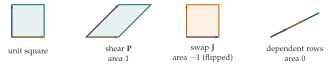
Geometrically, a \(2 \times 2\) matrix sends the unit square to a parallelogram, and \(\det\mathbf{M}\) is its signed area: positive if the orientation is preserved, negative if it is reversed (Figure 7.3.1). The multiplicative property then has an obvious meaning: doing two transformations in turn multiplies their area scale factors. A row swap reverses orientation, which is why \(\det\mathbf{J} = -1\); a shear slides the square into a parallelogram of the same area, which is why \(\det\mathbf{P} = 1\); and a matrix with dependent rows squashes the square flat, which is why its determinant is zero. Every step of the question has a picture.
Determinants in higher dimensions
For \(n \times n\) matrices the determinant is the signed volume scale factor, and it is characterised by three properties: it is linear in each row, it changes sign when two rows are swapped, and it equals \(1\) on the identity. From these alone you can derive the familiar expansion formulas, and Gaussian elimination gives an efficient way to compute it. The determinant appears in the change-of-variables formula for multiple integrals (the Jacobian), in the formula for the inverse of a matrix, and, as we saw in Section 5.4, in the discriminant of a polynomial.
The thinking skill
When a function is known only through a property, apply the property to the simplest special inputs you can think of, and see what it forces.
Here the identity, a swap, a scaling and a shear were enough to determine almost everything. Choosing inputs that are their own squares, inverses or conjugates is particularly effective.
Try this next
Other examples. Show that \(\mathrm{f}(\mathbf{M}) = (\det\mathbf{M})^3\) satisfies all the conditions of the question, and that \(\mathrm{f}(\mathbf{M}) = |\det\mathbf{M}|\) satisfies the multiplicative property but not \(\mathrm{f}(\mathbf{J}) \neq 1\).
Column operations. Show that \(\mathrm{f}\) is also zero on any matrix whose second column is a multiple of the first.
Scalings. Let \(\mathbf{K}_k = \begin{pmatrix} 1 & 0 \\ 0 & k \end{pmatrix}\). Show that \(\mathrm{f}\begin{pmatrix} k & 0 \\ 0 & 1 \end{pmatrix} = \mathrm{f}(\mathbf{K}_k)\), and that \(\mathrm{f}(\mathbf{K}_k)\mathrm{f}(\mathbf{K}_l) = \mathrm{f}(\mathbf{K}_{kl})\).
Reduction to the determinant. harder Show that every invertible \(2 \times 2\) matrix can be written as a product of matrices of the forms \(\mathbf{J}\), \(\mathbf{K}_k\) and \(\begin{pmatrix} 1 & t \\ 0 & 1 \end{pmatrix}\). Deduce that \(\mathrm{f}(\mathbf{M})\) depends only on \(\det\mathbf{M}\).
Further reading
Sheldon Axler, Linear Algebra Done Right (Springer; free online). Defines the determinant from its properties, in the spirit of this question.
Gilbert Strang, Introduction to Linear Algebra (Wellesley-Cambridge). Chapter 5 develops determinants from three rules.
3Blue1Brown, “The determinant” (video, free online). The area interpretation, beautifully animated.